

March 25, 2026 (Wednesday)
When the CEO’s Wealth Is Tied to YOUR Wealth — Magic Happens
On March 25, 2026, the Sensex surged over 1,600 points to 75,708 levels while the Nifty crossed 23,430 — rallying on hopes of de-escalation in West Asia tensions. In times like these, when markets swing wildly, one type of company consistently outperforms over the long term: owner-operator companies — businesses where the founder or promoter runs the company AND holds a significant stake.
This is one of the most powerful yet overlooked concepts in value investing. When the person making decisions has their own wealth on the line, the quality of those decisions improves dramatically. As Warren Buffett famously said: “Never ask a barber if you need a haircut.” Similarly, never trust a hired manager as much as an owner who eats their own cooking.
What Exactly Is an Owner-Operator Company?
An owner-operator company is one where the founder, promoter, or a key family member:
- Holds a significant equity stake (typically 40%+ promoter holding)
- Actively manages day-to-day operations — not just sitting on the board
- Has their personal wealth tied to the company’s success
- Thinks in decades, not quarters
In India, some of the greatest wealth creators have been owner-operator businesses. Think of Radhakishan Damani with DMart (Avenue Supermarts), Azim Premji with Wipro in its early days, or the Bajaj family with Bajaj Finance. These promoters didn’t just “manage” — they built empires because their skin was in the game.
The Data Speaks: Why Owner-Operators Outperform
Research consistently shows that companies with high promoter holding and active promoter involvement outperform the broader market. Here’s why:
1. Superior Capital Allocation
When it’s YOUR money, you don’t waste it on vanity acquisitions or empire-building. Owner-operators tend to have higher Return on Capital Employed (ROCE) because they treat every rupee as sacred. A study by Marcellus Investment Managers found that companies with “skin in the game” promoters delivered 3-5x better returns than professionally managed firms over a 15-year period.
2. Long-Term Thinking Over Short-Term Pressures
Hired CEOs often optimize for quarterly earnings to protect their bonuses. Owner-operators think about the next 20 years. They’ll sacrifice short-term profits to build lasting competitive advantages — whether it’s investing in R&D, building a distribution network, or developing proprietary technology.
3. Lower Agency Costs
In corporate finance, “agency costs” refer to the conflict between shareholders and management. When the CEO IS the largest shareholder, this conflict virtually disappears. No inflated executive compensation, no unnecessary corporate jets, no related-party transactions that benefit management at the expense of minority shareholders.
4. Faster Decision-Making
Owner-operators don’t need to go through five layers of bureaucracy to make a decision. When COVID-19 hit, many promoter-led companies pivoted within days — restructuring costs, finding new revenue streams, and protecting their balance sheets — while professionally managed companies were still forming committees.
How to Identify Great Owner-Operator Companies in India
Here’s a practical framework Indian investors can use:
The 5-Point Owner-Operator Checklist
✅ Promoter Holding Above 50%: Check BSE/NSE filings for promoter shareholding. Higher is generally better, but even 40%+ shows serious commitment. When promoters are INCREASING their stake through creeping acquisitions, that’s an even stronger signal.
✅ Promoter Actively Involved in Operations: Is the promoter the MD or CEO? Do they attend analyst calls? Do they visit factories and meet customers? A promoter who is just a chairman on paper doesn’t count.
✅ Minimal Pledge of Promoter Shares: If promoters have pledged a large portion of their shares as collateral for loans, it’s a red flag. It means they might be forced sellers if the stock price drops — creating a vicious cycle. Look for ZERO or minimal pledge.
✅ Consistent Dividend History: Owner-operators who pay consistent dividends are effectively paying themselves — and you along with them. This aligns interests beautifully.
✅ Clean Corporate Governance: No related-party transactions that smell fishy, no frequent auditor changes, no qualified audit opinions. Owner-operators with integrity build the best long-term businesses.
Real Indian Examples: Owner-Operators Who Created Massive Wealth
DMart (Avenue Supermarts) — Radhakishan Damani
Damani holds over 74% in DMart and is known for his frugal, no-nonsense approach. He built India’s most profitable retail chain by focusing on everyday low prices, owning (not leasing) store properties, and keeping debt minimal. DMart’s stock has delivered over 500% returns since its IPO in 2017.
Bajaj Finance — The Bajaj Family
The Bajaj family’s active involvement transformed a sleepy manufacturing finance company into India’s most dynamic NBFC. With promoter holding around 56%, the family’s wealth rises and falls with every investor — a powerful alignment of interests.
Titan Biotech — A Micro-Cap Owner-Operator Success Story
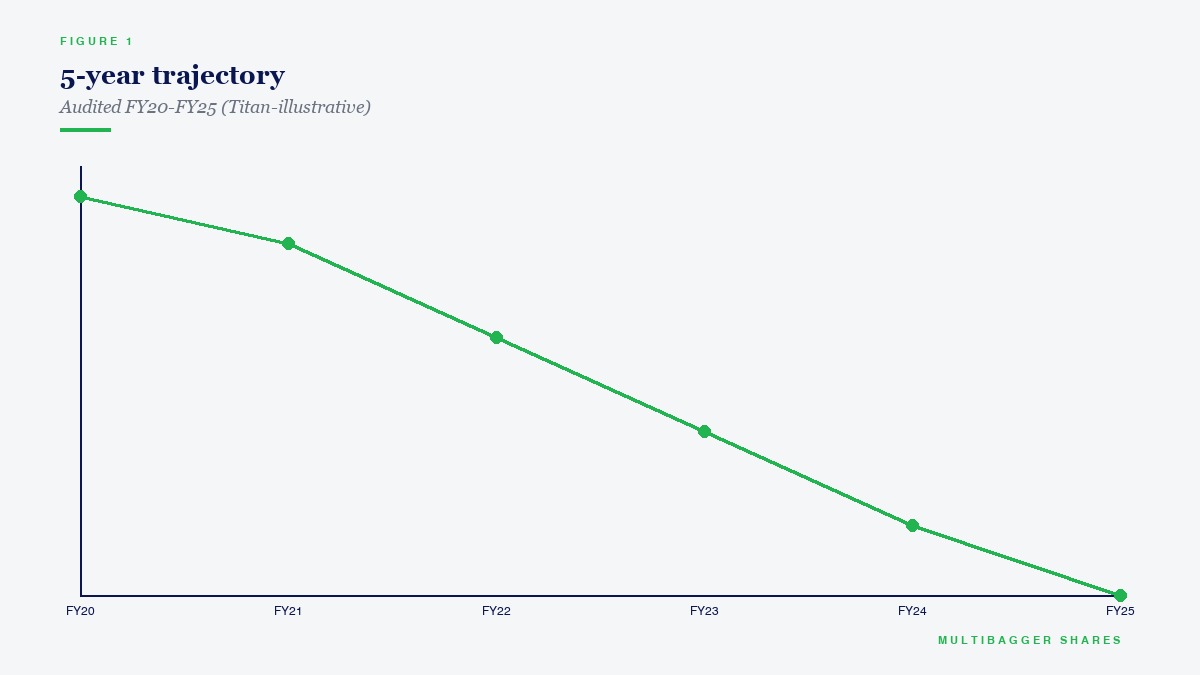
Titan Biotech Ltd (currently trading around ₹335-378 on NSE) is a fascinating example of an owner-operator company in the niche biotechnology space. With strong promoter involvement and a focused business model in agar, gelatin, and biotech products, this company exemplifies how dedicated founder-led management can create value even in small-cap territory. The stock has delivered exceptional returns — over 200% gains from levels around ₹55 — rewarding patient investors who recognized the owner-operator advantage early.
The Warning Signs: When Owner-Operators Go Wrong
Not every promoter-led company is a winner. Watch out for these red flags:
🚩 Excessive Related-Party Transactions: When the promoter’s other businesses are getting sweetheart deals from the listed entity, minority shareholders are being short-changed.
🚩 Promoter Selling Shares Consistently: If the person who knows the business best is reducing their stake quarter after quarter, ask yourself: what do they know that you don’t?
🚩 Empire Building Without Returns: Some promoters diversify into unrelated businesses, destroying value. Stick with focused owner-operators who dominate their niche.
🚩 High Promoter Pledge: Pledging above 30-40% of promoter holding is dangerous. Companies like the erstwhile Essel Group and some ADAG Group companies suffered massive declines partly due to promoter pledge unwinding.
Building Your Owner-Operator Portfolio: A Practical Strategy
Here’s how you can systematically find and invest in owner-operator companies:
Step 1: Screen for High Promoter Holding. Use free screeners on Screener.in or Trendlyne to filter for companies with 50%+ promoter holding and increasing trends.
Step 2: Check Management Quality. Read annual reports — specifically the Chairman’s letter. Is it candid about challenges, or is it all PR fluff? Great owner-operators like Warren Buffett (Berkshire Hathaway) and Narayana Murthy (Infosys in early days) were brutally honest with shareholders.
Step 3: Verify Financial Discipline. Look for consistent ROCE above 15%, low debt-to-equity ratios, and healthy free cash flow generation. Owner-operators who are good capital allocators will shine on these metrics.
Step 4: Buy at Reasonable Valuations. Even the best owner-operator company is a bad investment at the wrong price. Apply a margin of safety — wait for the stock to trade below its intrinsic value before buying.
Step 5: Hold for the Long Term. The magic of owner-operator investing comes from compounding over decades. Don’t trade in and out. As Charlie Munger said: “The big money is not in the buying and selling, but in the waiting.”
Why This Matters More Than Ever in 2026
With the Nifty showing increased volatility — swinging hundreds of points on geopolitical news like the US-Iran situation — it’s tempting to trade actively. But SEBI data consistently shows that over 90% of F&O traders lose money. The smarter path? Find great owner-operator companies, buy them at fair prices, and let compounding do the heavy lifting.
The Indian economy is projected to become the world’s third-largest by 2028. Healthcare and biotechnology, digital infrastructure, and the consumption story are creating enormous opportunities. Owner-operator companies in these high-growth sectors — those with founders who eat their own cooking — will likely create the next generation of multibaggers.
Your Action Plan
Today, spend 30 minutes screening for companies where:
- Promoter holding is above 50% and increasing
- Promoter pledge is zero or minimal
- ROCE is consistently above 15%
- The company is in a growing sector
- The stock trades at a reasonable valuation
This single filter — finding great owner-operators — can transform your investment returns over the next decade.
Want to learn value investing systematically? Watch our complete FREE Value Investing Course:
Disclaimer: This article is for educational purposes only and does not constitute financial advice. The stocks mentioned are for illustrative purposes. Always do your own research (DYOR) and consult a SEBI-registered financial advisor before making any investment decisions. Stock market investments are subject to market risk.
— Manish Goel | Value Investing with Manish Goel | manishgoelpms.com
📢 Join Our Telegram Channel
Get daily value investing lessons, stock analysis & Titan Biotech updates — delivered straight to your phone!
✈️ Join @longtermequityy on Telegram🔔 Free • No spam • Value investing insights daily