

Markets Stumble on Hormuz Blockade Fears — But This Is Where Fortunes Are Made
April 14, 2026 | Daily Market Commentary by Manish Goel | manishgoelpms.com
What Happened on Monday
Markets are closed today for Ambedkar Jayanti, giving investors a much-needed pause to reflect after a bruising Monday session. The last trading day — April 13 — painted the markets red across the board.
The NIFTY 50 fell 208 points (-0.86%) to close at 23,843, while the BSE SENSEX dropped 703 points (-0.91%) to settle at 76,848. Market breadth was devastatingly weak — out of the Nifty 50 constituents, only 10 stocks managed to advance while 39 declined. That tells you everything about the intensity of selling pressure.
The carnage was led by auto stocks — Eicher Motors crashed 5.04%, Maruti Suzuki fell 4.62% on fears of higher fuel costs and Delhi’s draft EV policy. Financial heavyweights were battered too — Bajaj Finance shed 2.93%, HDFC Bank dropped 2.14%, and Cholamandalam Finance lost 4.79%. Even IT majors couldn’t escape the gravity — TCS fell 2.12%, HCL Tech declined 1.56%, and Infosys slipped 1.28%. Reliance Industries, the market’s largest weight, dropped 2.68%.
Among the rare bright spots were ICICI Bank (+1.85%), NTPC (+1.62%), and Tata Motors (+0.99%).
Why It Happened — The Hormuz Factor
The trigger was loud and clear: geopolitics. US-Iran peace talks in Islamabad ended in a stalemate over the weekend, and then President Trump escalated the situation dramatically by announcing that the US Navy would begin enforcing a blockade of the Strait of Hormuz — the narrow waterway through which roughly 20% of the world’s oil supply flows.
The impact was immediate and severe. Crude oil prices surged over 8% in early trading, with both Brent and WTI breaching the $100 per barrel mark before settling around $97-98. For context, oil had already touched $112 per barrel on April 7 before a temporary ceasefire brought it down. This yo-yo pattern reflects the deep uncertainty gripping energy markets.
For India — which imports over 85% of its crude oil — this is a particularly dangerous situation. The rupee has already crossed the ₹93/USD mark, and every $10 increase in crude oil prices adds roughly 0.4% to India’s current account deficit. Rising fuel costs feed directly into inflation, squeeze corporate margins, and reduce consumer spending power. Auto stocks were punished precisely because of this chain reaction.
What This Means for Investors
Let me be direct with you: this kind of fear-driven selling creates the very conditions that make long-term wealth creation possible.
When the market falls because of geopolitical events — not because Indian companies suddenly forgot how to do business — you are looking at a temporary dislocation between price and value. The underlying businesses haven’t changed. Their factories are still running, their customers are still buying, their order books are still intact.
What has changed is sentiment. And sentiment, as every serious investor knows, is the worst possible guide for investment decisions. The traders who panic-sold Maruti at a 4.62% loss on Monday are reacting to headlines. The investors who understand Maruti’s business — its market share, its cash generation, its long-term competitive position — know that one week’s oil price movement doesn’t destroy a great business.
Here’s the critical question you should ask yourself: Are you investing based on tomorrow’s headlines, or based on a company’s ability to generate earnings over the next decade? If it’s the latter, days like Monday are gifts, not disasters.
The Value Investor’s Perspective
Warren Buffett has said it better than anyone: “Be fearful when others are greedy, and greedy when others are fearful.” With 39 out of 50 Nifty stocks declining on Monday, I’d say fear is well and truly in the driver’s seat.
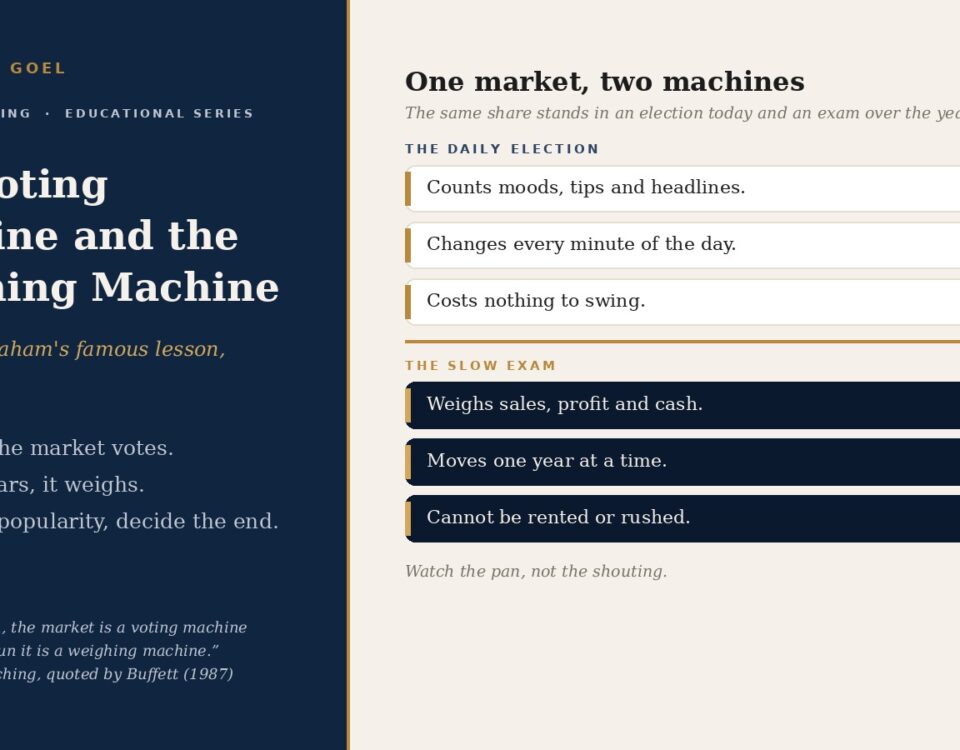
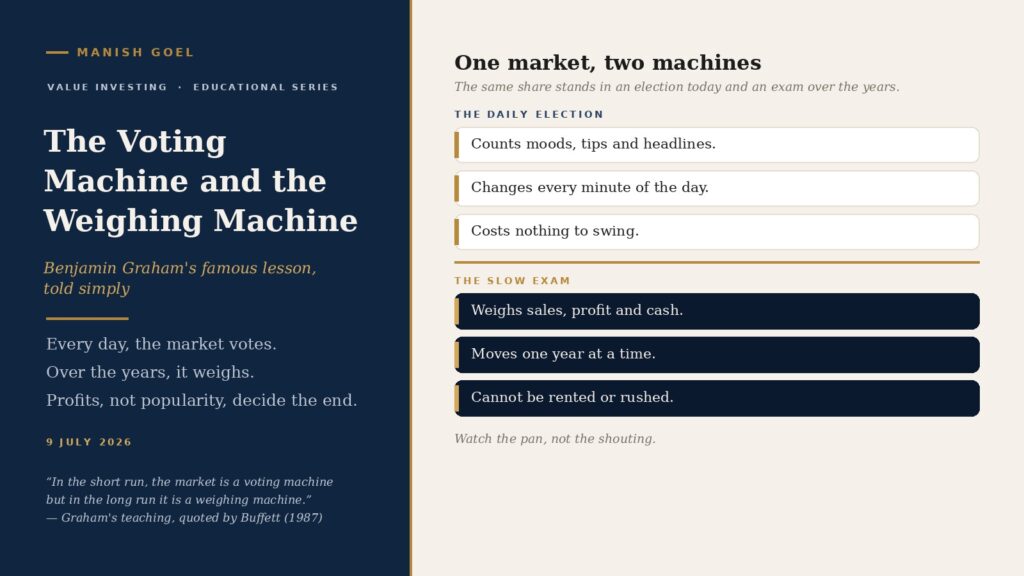
Benjamin Graham, the father of value investing, taught us that Mr. Market is manic-depressive. Some days he offers you absurdly high prices for your stocks. Other days — like Monday — he offers you ridiculously low prices. Your job as an intelligent investor is not to follow Mr. Market’s mood swings. Your job is to exploit them.
The greatest fortunes in stock market history have been built during periods of exactly this kind of uncertainty. Rakesh Jhunjhunwala made his billions not by running away from crashes but by running toward quality businesses when everyone else was running away. Charlie Munger built concentrated positions in deeply researched businesses and held them through every crisis. They didn’t dilute their conviction across 50 mediocre stocks — they concentrated their capital in their best 5-10 ideas and had the courage to hold through turbulence.
As Buffett himself said: “Wide diversification is only required when investors do not understand what they are doing.” If you’ve done the deep research — if you truly understand a business using a rigorous framework — you don’t need 50 stocks to sleep at night. You need 5-10 of the best, and the discipline to hold them.
💎 Titan Biotech — Quality Compounds While Markets Panic
While markets tumbled and traders scrambled to exit positions, it’s worth remembering what truly matters: business fundamentals. Titan Biotech delivered a staggering 94% profit growth last quarter while the market was in full panic mode. This is the hallmark of a genuine compounder — a business that grows regardless of what Mr. Market does on any given Monday. Geopolitical tensions come and go. Oil prices rise and fall. But a business with strong fundamentals, growing demand, and excellent management continues to create value quarter after quarter. While others are watching CNBC tickers in fear, the smart money is quietly accumulating businesses like these. This is where multibaggers are born — not in bull market euphoria, but in the depths of fear.
Your Action Plan
1. Do NOT sell quality in panic. If you own fundamentally strong businesses, this is the worst time to sell. You’d be locking in losses driven by temporary sentiment, not business deterioration.
2. Use this holiday to review, not react. Markets are closed today. Instead of doom-scrolling through news, use this time to review the fundamentals of your holdings. Are their revenues growing? Are profit margins intact? Is management executing well? If yes, hold firm.
3. Build a watchlist of quality businesses trading at fear-discounted prices. Days like Monday create buying opportunities in businesses that the market has unfairly punished. Identify them now, so you’re ready to act when markets reopen.
4. Concentrate your research, not your panic. True risk management comes from the depth of your understanding, not from spreading capital across dozens of mediocre stocks. Know your 5-10 best ideas deeply.
🚫 STAY AWAY FROM F&O — This Is Not Investing, It’s Gambling
Days like Monday are when F&O traders get destroyed. The SEBI data consistently shows that over 90% of F&O traders lose money. Volatile sessions driven by geopolitical shocks are the absolute worst time to be trading derivatives. The leverage that promises quick profits is the same leverage that wipes out accounts overnight. Real wealth is built through patient, long-term investing in quality businesses — not through gambling on short-term price movements. If you’re currently involved in F&O trading, I urge you to stop immediately and redirect that capital into deeply researched, high-conviction equity positions. Your future self will thank you.
📚 Learn Value Investing — Free Course by Manish Goel
Want to learn how to identify multibagger stocks using our proven 95-factor framework? Watch our complete free course playlist and transform the way you invest.
Disclaimer: This commentary is for educational purposes only and does not constitute investment advice. The views expressed are personal opinions of Manish Goel and the editorial team at manishgoelpms.com. Stock market investments are subject to market risks. Please do your own research or consult a SEBI Registered Research Analyst before making any investment decisions. Past performance is not indicative of future results.
© 2026 manishgoelpms.com | By Manish Goel