

April 10, 2026 (Friday)
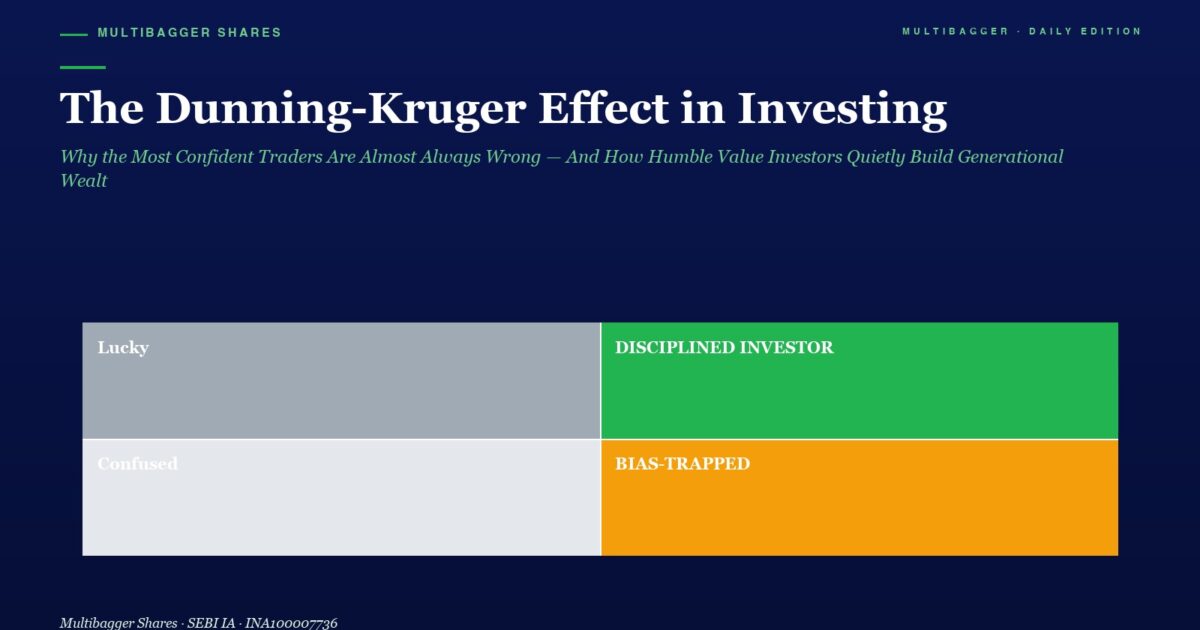
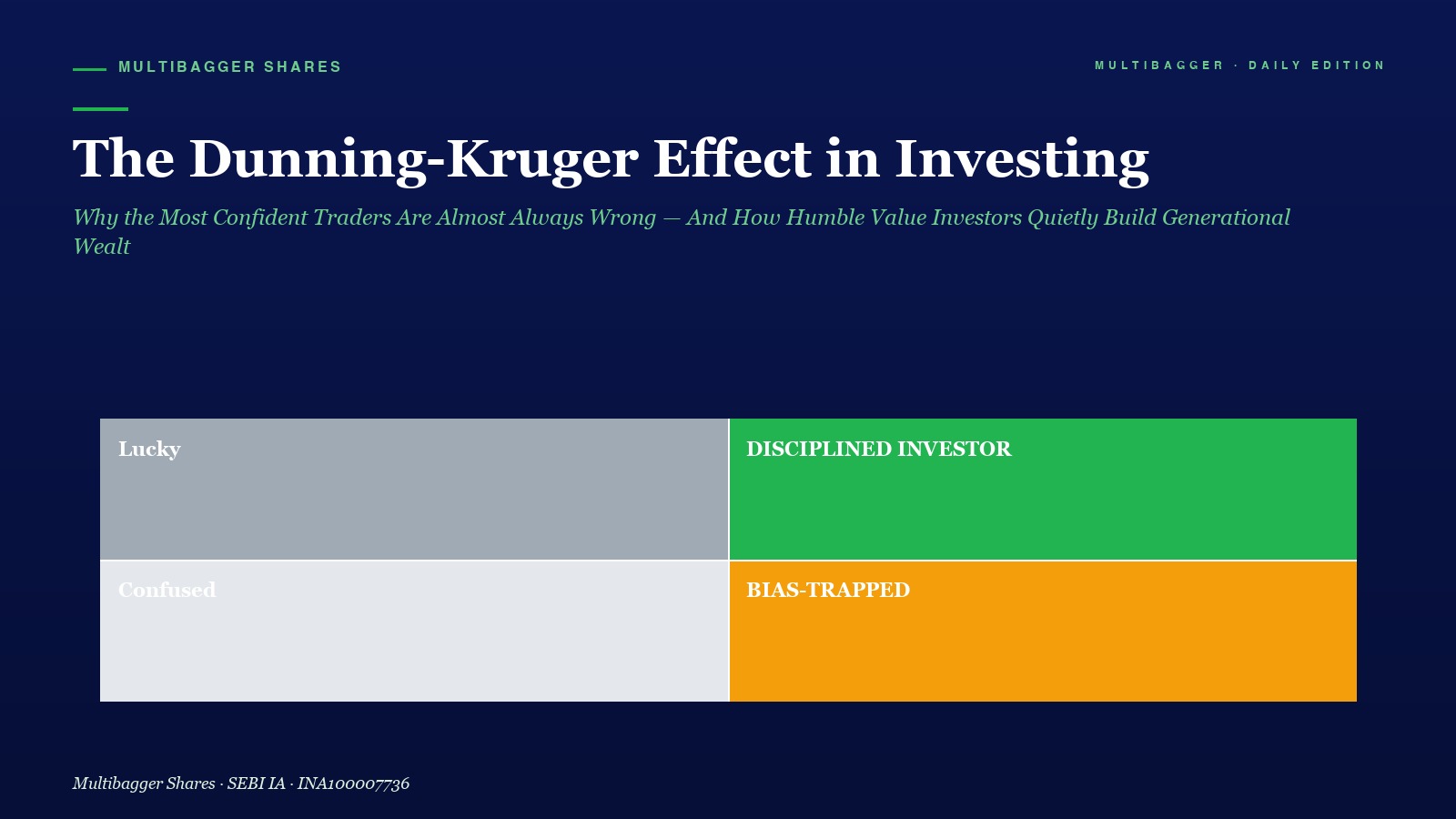
The Dunning-Kruger Effect in Investing: Why the Most Confident Traders Are Almost Always Wrong — And How Humble Value Investors Quietly Build Generational Wealth
In 1999, two Cornell psychologists — David Dunning and Justin Kruger — published a landmark study with a title that could have been written specifically for the Indian stock market: “Unskilled and Unaware of It: How Difficulties in Recognizing One’s Own Incompetence Lead to Inflated Self-Assessments.” The findings were devastating. People with the least knowledge in a domain consistently rated themselves as the most skilled. The less they knew, the more certain they became that they knew everything.
Fast-forward 27 years. Today, April 10, 2026, the BSE Sensex closed at 77,550.25 (+1.20%) and the NIFTY 50 at 24,050.60 (+1.16%) — a firmly positive day driven by quality large-caps. Yet in WhatsApp groups, Telegram channels, and “finfluencer” YouTube reels across India, millions of retail traders are convinced they can “beat the market” using chart patterns, option spreads, and gut-feel “breakout” calls. They are the walking embodiment of the Dunning-Kruger effect — and the data proves it.
SEBI’s landmark 2023 study — reaffirmed in its follow-up 2024 report — concluded that 9 out of 10 individual traders in the equity Futures & Options segment incur net losses. The average loss per trader was roughly ₹1.1 lakh. The top 1% of loss-makers lost an average of ₹28 lakh each. These were not random unlucky souls. They were confident, active, self-taught “traders” who believed, sincerely and passionately, that they were part of the special 10% who would win.
This post is about why that confidence is mathematically delusional, how the Dunning-Kruger effect silently destroys retail portfolios, and — most importantly — how the humble, boring, research-driven path of value investing (the one Warren Buffett, Charlie Munger, and Rakesh Jhunjhunwala walked) is the only escape hatch from this psychological trap.
What Exactly Is the Dunning-Kruger Effect?
In plain language, the Dunning-Kruger effect is the cognitive bias in which people with low ability in a domain suffer from illusory superiority, mistakenly assessing their cognitive ability as greater than it actually is. Critically, this bias is driven by “metacognitive inability” — the very knowledge required to evaluate one’s own performance is the same knowledge one lacks.
When you plot confidence on the Y-axis and actual competence on the X-axis, you get a distinctive curve:
- Stage 1 — “Peak of Mount Stupid”: After learning a few terms (support, resistance, P/E ratio, breakout), confidence skyrockets. The beginner believes they have “figured out” the market.
- Stage 2 — “Valley of Despair”: As they begin to actually engage with real capital, they discover how much they don’t know. Confidence crashes.
- Stage 3 — “Slope of Enlightenment”: With deliberate study, humility, and years of experience, competence begins to slowly rise again.
- Stage 4 — “Plateau of Sustainability”: True expertise — where confidence and competence finally align. This is where the great value investors live.
The tragedy is that most Indian retail F&O traders never leave Stage 1. They blow up, rage-quit, blame the market, and disappear — never understanding that they were the problem, not the system.
The Indian Context: Why Dunning-Kruger Is a National Epidemic in Our Markets
India has roughly 11.9 crore demat accounts as of early 2026 — a staggering 10x jump from 2020. But the overwhelming majority of these accounts belong to first-time investors who skipped straight to F&O, intraday trading, or crypto derivatives without ever learning to read a balance sheet. This is Dunning-Kruger at national scale.
Consider three real symptoms I see every single day in my interactions with retail investors:
Symptom 1 — “I’ve been watching charts for 6 months, so I understand technicals.” Six months of watching candlesticks is the investing equivalent of watching six months of surgery videos on YouTube and then volunteering to perform an appendectomy. Pattern recognition without statistical validation is superstition. Real technical analysts spend decades understanding why most “patterns” are random noise.
Symptom 2 — “Value investing is too slow. I want quick returns.” This statement reveals two Dunning-Kruger layers simultaneously: (a) underestimating how hard it is to generate “quick returns” consistently, and (b) overestimating one’s own ability to do what 90% of professional fund managers cannot do. Being “in a hurry” in the stock market is the fastest way to lose money slowly, and then quickly.
Symptom 3 — “I made ₹50,000 last month on Nifty options. I’m on a roll.” One month of gains in a 23,000-point Nifty rally is not skill. It is survivorship luck in a bull market. The cruel math of F&O is that this “winner” will eventually give back not just the ₹50,000 but several multiples of it — because Dunning-Kruger will convince them to increase position size just in time for the inevitable reversal.
The Math of Overconfidence: Why F&O Is Mathematically Designed to Destroy Retail
Here is a data point that every Indian investor should tattoo on their brain: SEBI’s study found that the aggregate net loss of individual F&O traders was over ₹51,000 crore in FY22 alone. Where did that money go? It went to algorithmic trading desks, proprietary firms, foreign institutional players, and option sellers with deep capital pools.
The F&O segment is a zero-sum game before costs, and a negative-sum game after brokerage, STT, exchange fees, GST, and slippage. For every rupee won by a winner, a rupee is lost by a loser — and then both pay “rent” to the exchange and broker. The house always wins.
Dunning-Kruger whispers: “Yes, 90% lose — but I’m in the 10%.” The honest question every retail trader must ask is: What specifically makes me different from the 90%? Superior capital? No. Superior data? No. Superior execution speed? No. Years of institutional training? No. The only honest answer, for almost everyone, is: nothing at all.
The Antidote: How Value Investing Forces Humility — And Rewards It Enormously
Warren Buffett, arguably the greatest investor in history, once said something that sounds almost like a rebuke to the Dunning-Kruger crowd: “Risk comes from not knowing what you are doing.” And then he added the Sphinx-like corollary: “Wide diversification is only required when investors do not understand what they are doing.”
Notice what Buffett is really saying. He is not dismissing diversification because he is arrogant. He is saying the opposite — that if you are humble enough to acknowledge you cannot deeply understand 50 businesses, you should concentrate your capital in the 5-10 you genuinely can. The Dunning-Kruger trap is diversifying across 50 “tips” you barely understand, mistaking breadth for knowledge. The value investor’s path is to concentrate conviction, rooted in deep, verified, fundamental research.
This is why the greatest investors of all time — Buffett, Munger, Seth Klarman, Mohnish Pabrai, Rakesh Jhunjhunwala, Radhakishan Damani — all run concentrated portfolios. They spent decades climbing out of the Valley of Despair and onto the Plateau of Sustainability. They know exactly how much they don’t know, and they bet heavily only where their knowledge is unambiguous.
Case Study: Titan Biotech — A Boring Business That Quietly Built Wealth for Patient Investors
Let me contrast the Dunning-Kruger trader with the humble value investor using a real, ongoing example from our research universe: Titan Biotech Ltd (BSE: 524717). As of today’s close, the stock trades at ₹432 with a market cap of ₹1,783 Cr, a 52-week range of ₹74.7 to ₹556, a Stock P/E of 65.6, Book Value of ₹40.3, Face Value of ₹2, ROCE of 16.9%, and ROE of 15.0%.
Now, here is what the Dunning-Kruger trader sees: “Biotech? Small-cap? P/E of 65? Too risky, too boring, no chart breakout.” They scroll past it to enter a Bank Nifty weekly option that expires in three days.
Here is what the humble value investor sees: An ISO 9001:2008 certified, cGMP-compliant manufacturer and exporter of biological products, selling across pharmaceutical, nutraceutical, and industrial enzyme categories in 100+ countries. A business that has compounded book value roughly 9x over a decade, has zero promoter pledging, a clean governance track record, a strong R&D pipeline, rising capacity utilization, and earnings that are backed by real operating cash flows. They also see that the stock has already moved from ₹74 to ₹432 in 52 weeks — a multi-fold re-rating that handsomely rewarded investors who did the homework before the crowd noticed.
The humble investor is not asking “What will Titan Biotech do next week?” That is a Dunning-Kruger question. They are asking “Is the underlying business genuinely improving over 3-5 years? Is the management aligned with shareholders? Is the balance sheet getting stronger? Are operating cash flows supporting reported profits?” These are questions you can actually answer with research, patience, and intellectual honesty — which is exactly what our 95-factor Titan Biotech research framework has been documenting, one factor at a time.
Five Practical Habits to Escape the Dunning-Kruger Trap Starting Today
1. Write your investment thesis in one paragraph — before you buy. If you cannot articulate in plain English why you are buying a stock, what will make it work, and what will tell you that you were wrong, you do not understand the investment. This single discipline exposes Mount Stupid instantly.
2. Pre-commit to a holding period of at least 3 years. This filters out 95% of Dunning-Kruger behaviour, which is rooted in short-term overconfidence. If you cannot hold it for 3 years, you should not own it for 3 minutes.
3. Follow the “I do not know” rule. Every investor should be able to list ten things they explicitly do not know about any stock they own. If you cannot, you are bluffing yourself. The most dangerous four words in investing are “I’ve got this figured.”
4. Keep a decision journal. Write down every buy and sell along with the reasoning at the time of decision. Review it a year later. The gap between what you thought you knew and what actually happened is the Dunning-Kruger gap — and seeing it in your own handwriting is the most humbling experience any investor can have. It is also the fastest path to actual competence.
5. Replace F&O with fundamentals. If you have been trading derivatives, the single greatest wealth-building decision you can make today is to close the F&O account, transfer that capital to a delivery-based equity portfolio of 5-10 deeply researched businesses, and commit to holding them for a decade. SEBI’s own data says 90% of F&O traders lose money. The 10% who “succeed” are overwhelmingly institutions. Value investing is not slower — it is simply the only path with a positive expected outcome for retail investors.
The Humble Truth About Markets
The stock market does not reward the loudest, most confident, most active, or most chart-obsessed participants. It rewards those who admit, every single day, that the future is uncertain, that businesses are complex, and that patience is a superpower. The greatest compounders in Indian market history — Infosys, Asian Paints, HDFC Bank, Titan, Page Industries, Bajaj Finance — were built by the founders and sustained by investors who escaped the Dunning-Kruger trap. They bought quality, held through noise, ignored tips, and let compounding do what compounding does.
If you are reading this and you have ever said to yourself, “I’ve got the markets figured out”, please consider it a gift if you feel a small pang of doubt right now. That doubt is the beginning of wisdom. That doubt is the first step off Mount Stupid. That doubt — if you nurture it into a lifetime habit of humble, deep, fundamental research — is worth more than any chart pattern you will ever learn.
The richest investors are not the ones who “beat” the market. They are the ones who respected it enough to let it make them rich slowly, over decades, one well-researched business at a time.
For those who want to walk that humble, rigorous path with us, our complete value investing education series on YouTube is available here: The Manish Goel Portfolio Management Service Value Investing Course. There is no magic, no tips, no shortcuts — just the slow, honest work of understanding businesses deeply enough to bet heavily on the best of them.
SEBI Disclaimer: 9 out of 10 individual traders in the equity Futures & Options segment incurred net losses according to a SEBI study. F&O trading is essentially gambling. Focus on quality stock picking and long-term value investing instead.
Disclaimer: The author (Manish Goel) is a SEBI Registered Research Analyst (Registration No. INH100004775) and Manish Goel Portfolio Management Service (Manish Goel) is a SEBI Registered Research Analyst (Registration No. INH100004775). This post is for educational purposes only and should not be construed as a buy/sell recommendation. Please do your own research and consult a qualified financial advisor before making investment decisions. Stock market investments are subject to market risks. Past performance is not indicative of future results.
📢 Join Our Telegram Channel
Get daily value investing lessons, stock analysis & Titan Biotech updates — delivered straight to your phone!
✈️ Join @longtermequityy on Telegram🔔 Free • No spam • Value investing insights daily