

April 06, 2026 (Monday)
Today’s market snapshot — SENSEX: 73,548 (+0.31%) | NIFTY 50: 22,801 (+0.39%) | Titan Biotech (BSE: 524717): ₹529, Market Cap ₹2,187 Cr, ROCE 16.9%
The Five Most Expensive Words in Investing: “Let Me Book My Profits”
Every investor has heard the voice. The stock you bought at ₹100 is now at ₹300. Your portfolio shows a handsome green number. And then comes that irresistible whisper: “Book your profits. Lock in the gains. You can always buy back later.”
That whisper has destroyed more wealth than any market crash in history.
Warren Buffett settled this debate decades ago with six words that should be tattooed on every investor’s mind:
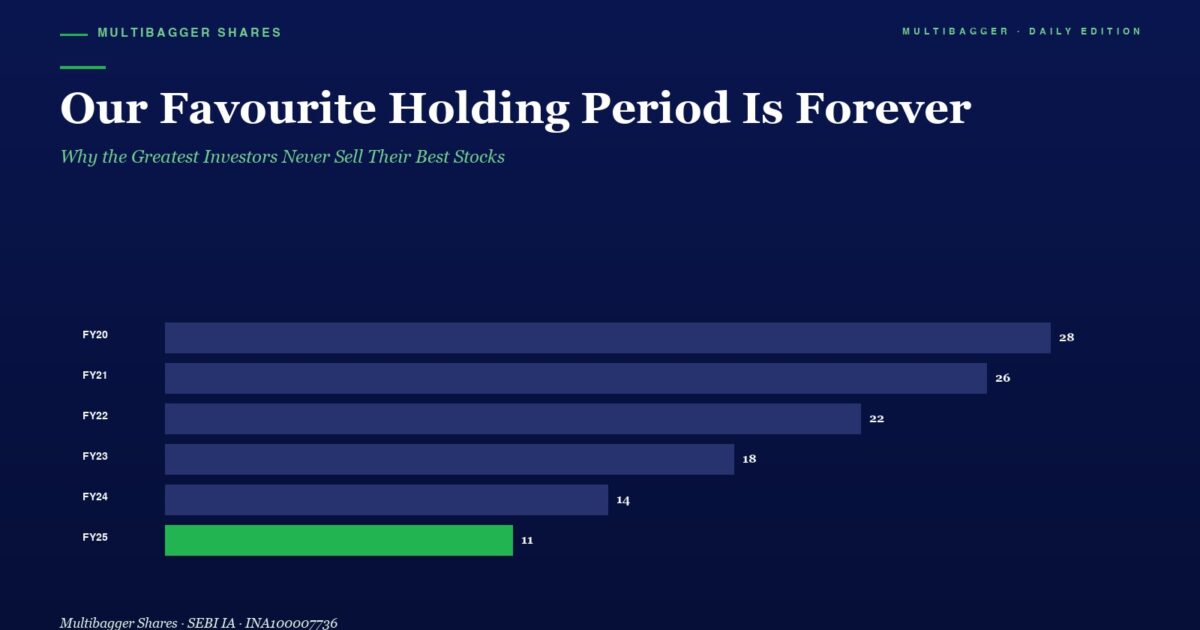
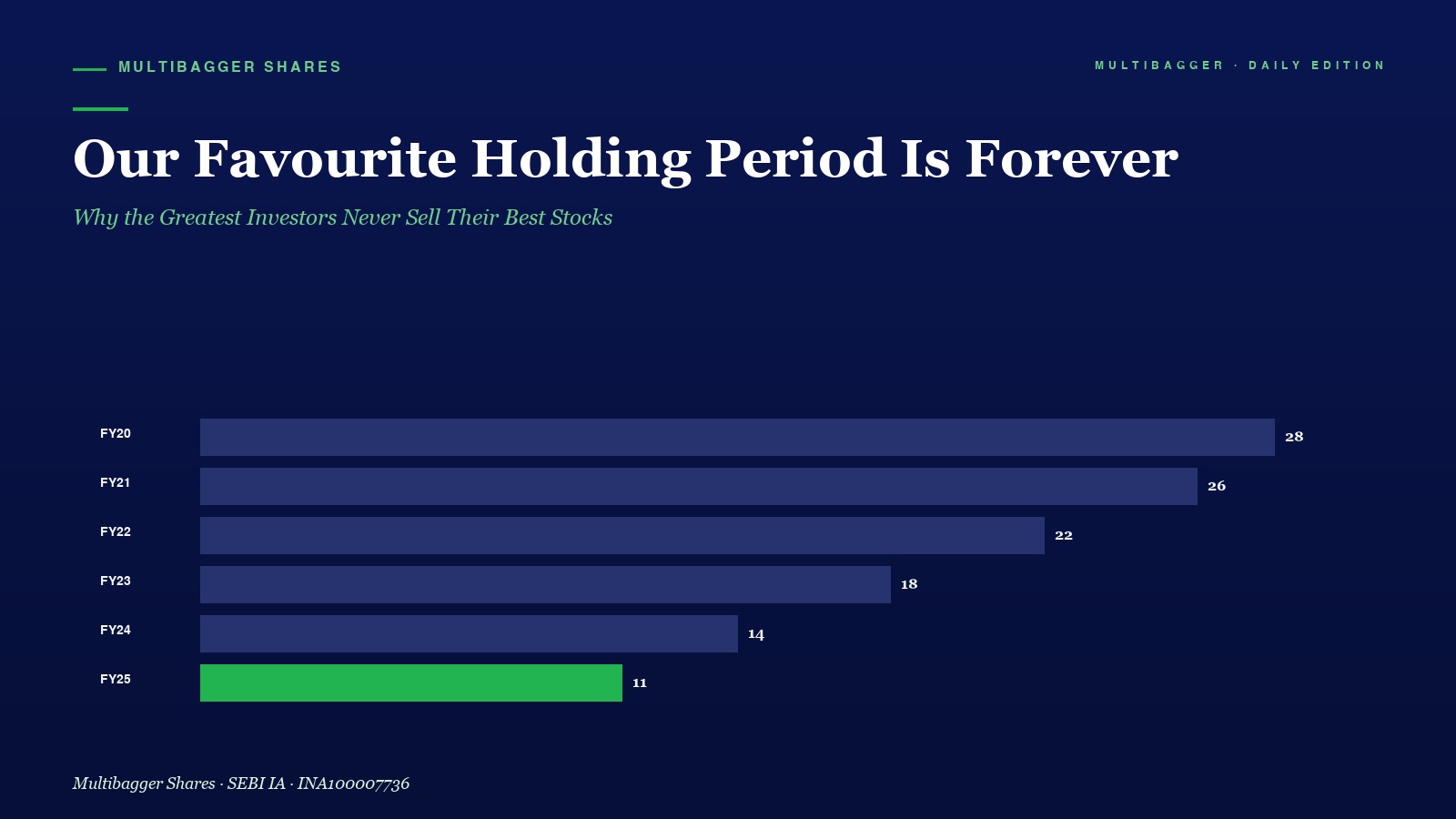
“Our favourite holding period is forever.”
— Warren Buffett
This isn’t a platitude. It’s not motivational fluff. It is the single most important operating principle behind the greatest wealth creation machine in market history — Berkshire Hathaway. And when you truly understand why Buffett says this, it transforms everything about how you approach the stock market.
The Tyranny of “Profit Booking”: A Mathematical Catastrophe
Let’s demonstrate with cold, hard numbers why selling winners is the most expensive habit an investor can develop.
Imagine you bought shares of a truly exceptional company — one with durable competitive advantages, honest management, and a long runway of growth. You bought at ₹100.
The “Smart” Profit Booker: Sells at ₹300 (200% gain), pays 12.5% Long-Term Capital Gains tax, nets ₹275. Waits for a dip that never comes. The stock reaches ₹900 in 3 more years. ₹1,500 in 5 years. ₹5,000 in 10 years. But our “smart” investor is sitting on the sidelines with ₹275, having sold the golden goose for a single egg.
The Patient Holder: Does nothing. Endures the 20% drawdowns, ignores the “overvalued” calls, holds through quarterly noise. After 10 years, ₹100 has become ₹5,000 — a 4,900% return. No tax paid. No re-entry anxiety. No timing stress. Just compounding doing its magnificent, silent work.
This is why Buffett’s partner Charlie Munger said something devastatingly simple:
“The first rule of compounding: Never interrupt it unnecessarily.”
— Charlie Munger
Every time you sell a great business, you reset the compounding clock to zero. You take a tax hit. You face the agonising decision of when to re-enter. And study after study shows that investors who sell and try to buy back almost never do — they watch from the sidelines as their former holding compounds without them.
The Evidence: What Happened to Those Who Actually Held Forever
Rakesh Jhunjhunwala and Titan Company: The ₹46,000 Crore Hold
India’s legendary Big Bull Rakesh Jhunjhunwala began accumulating Titan Company shares in 2002-2003 at prices around ₹3-5 (split-adjusted). There were a hundred reasons to sell along the way — the 2008 global financial crisis, slowdowns, quarterly earnings misses, competitor threats. Analysts repeatedly called Titan “overvalued.” Profit-booking advice came from every direction.
Jhunjhunwala held. And held. And held.
By the time of his passing in 2022, his Titan position alone was worth over ₹11,000 Crores. His total portfolio exceeded ₹46,000 Crores. The foundation of this staggering wealth? Not trading. Not timing. Not profit-booking. Simply holding an extraordinary business and letting compounding do its work over two decades.
Warren Buffett and Coca-Cola: 35 Years and Counting
Buffett bought Coca-Cola shares in 1988 for approximately $1 billion. In the 37 years since, he has never sold a single share. Today that position is worth over $25 billion, and Berkshire receives roughly $776 million per year in dividends from Coca-Cola — meaning Buffett now earns back 77% of his original investment in dividends alone, every single year, while still owning the entire position.
Buffett explained this beautifully:
“When we own portions of outstanding businesses with outstanding managements, our favourite holding period is forever. We are just the opposite of those who hurry to sell and book profits when companies perform well.”
— Warren Buffett, 1988 Shareholder Letter
Radhakishan Damani and Avenue Supermarts (DMart): Patient Capital Personified
Radhakishan Damani, one of India’s most private and most successful investors, built Avenue Supermarts (DMart) from the ground up in 2002. When the company went public in 2017, Damani’s holding was valued at approximately ₹44,000 Crores. While market pundits debated whether DMart was “too expensive” at its IPO price, Damani held his position, understanding what he had built over 15 years of patient, focused effort. His fortune today stands at over ₹1.5 Lakh Crores — built not by trading, but by building and holding.
The Infosys Story: India’s Eternal Compounding Machine
If you had invested just ₹10,000 in Infosys at its IPO in 1993 and simply held — done absolutely nothing for 30 years — your investment would have grown to over ₹7 Crores (with bonuses and splits). But here’s the painful truth: fewer than 1% of original Infosys investors still hold the stock today. The vast majority sold during the first 200-300% gain, convinced they were “locking in profits.” They locked in a fraction of the fortune that patience would have delivered.
Why Selling Winners Is Psychologically Irresistible — And Financially Ruinous
The urge to sell winners has deep psychological roots. Behavioural finance identifies it as the Disposition Effect — the tendency to sell winners too early (to feel the pleasure of a gain) while holding losers too long (to avoid the pain of acknowledging a loss).
The legendary investor Peter Lynch described this perfectly:
“Selling your winners and holding your losers is like cutting the flowers and watering the weeds.”
— Peter Lynch
Most investors do exactly this. They sell stocks up 100% (“too risky now, let me book profits”) and hold stocks down 50% (“it will come back”). This is the opposite of what every wealth-creating investor in history has done.
Philip Fisher, the father of growth investing whose influence shaped Buffett’s evolution, captured the philosophy with surgical precision:
“If the job has been correctly done when a common stock is purchased, the time to sell it is — almost never.”
— Philip Fisher, Common Stocks and Uncommon Profits
When IS It Right to Sell? The Only Three Legitimate Reasons
Holding forever doesn’t mean holding blindly. There are precisely three conditions under which selling is justified:
1. The Business Has Fundamentally Deteriorated. Not a bad quarter. Not temporary headwinds. A permanent, structural destruction of the competitive advantage that made you invest in the first place. If the moat is gone, the thesis is broken.
2. You Made a Mistake in Your Original Analysis. Honest reassessment reveals you missed something critical — perhaps forensic accounting red flags, governance issues, or a competitive dynamic you didn’t understand. This is an analytical error, not a price-based decision.
3. You’ve Found a Dramatically Better Opportunity. Not marginally better. Dramatically better. And even then, consider the tax friction and the compounding you’re interrupting before switching.
As Thomas Phelps wrote in his masterpiece 100 to 1 in the Stock Market:
“The biggest obstacle to making money in stocks is the urge to sell the stock that has gone up — and the inability to hold a good stock long enough.”
— Thomas Phelps
The Manish Goel Portfolio Management Service Approach: Buy Right, Sit Tight
At Manish Goel Portfolio Management Service, our investment philosophy is rooted in this eternal truth. When we evaluate a company through our rigorous 95-factor framework — examining forensic accounting, management quality, competitive moats, capital efficiency, growth runway, and survival probability — we are not looking for a trade. We are looking for a business we can own for a decade or more.
Consider Titan Biotech (BSE: 524717) — currently at ₹529 with a market cap of ₹2,187 Cr, ROCE of 16.9%, and ROE of 15.0%. When you’ve done this level of deep analysis and the business continues to compound capital at high rates, the last thing you want to do is sell because the price has gone up. Price going up in a quality business is not a reason to sell — it’s confirmation that your analysis was correct.
As Vijay Kedia, another legendary Indian investor, puts it:
“Buy right and hold tight. If you have found the right company, let time and compounding do the work. Your only job is to not interfere.”
— Vijay Kedia
Your Challenge: Train Yourself to Do Nothing
The hardest skill in investing is not analysis. It’s not stock picking. It’s not reading financial statements. The hardest skill is doing nothing after you’ve done everything right.
Buffett himself has said that his greatest investment returns have come not from brilliant entries, but from the discipline of not exiting:
“The stock market is a device for transferring money from the impatient to the patient.”
— Warren Buffett
So the next time your stock is up 200% and every fibre of your being screams “book profits” — remember that Jhunjhunwala’s ₹46,000 Crore fortune, Buffett’s $130 billion net worth, and Damani’s ₹1.5 Lakh Crore empire were all built by doing precisely the opposite of what your instincts demand.
To build this patience and analytical depth, follow our comprehensive Value Investing Course: Watch the full course on YouTube
Remember: 9 out of 10 individual traders in the equity Futures & Options segment incurred net losses according to a SEBI study. F&O trading is essentially gambling. The real money is not in trading — it’s in holding extraordinary businesses forever.
SEBI Disclaimer: 9 out of 10 individual traders in the equity Futures & Options segment incurred net losses according to a SEBI study. F&O trading is essentially gambling. Focus on quality stock picking and long-term value investing instead.
Disclaimer: The author (Manish Goel) is a SEBI Registered Research Analyst (Registration No. INH100004775) and Manish Goel Portfolio Management Service (Manish Goel) is a SEBI Registered Research Analyst (Registration No. INH100004775). This post is for educational purposes only and should not be construed as a buy/sell recommendation. Please do your own research and consult a qualified financial advisor before making investment decisions. Stock market investments are subject to market risks. Past performance is not indicative of future results.
📢 Join Our Telegram Channel
Get daily value investing lessons, stock analysis & Titan Biotech updates — delivered straight to your phone!
✈️ Join @longtermequityy on Telegram🔔 Free • No spam • Value investing insights daily