

16 April 2026 (Thursday)
Live market context (16 April 2026, 2:00 PM IST): SENSEX 77,796.02 (−315.22, −0.40%) · NIFTY 50 24,150.20 (−81.10, −0.33%) · FII inflow ₹666.15 Cr, DII outflow ₹568.98 Cr (15 Apr). A modest red day that reminds us why durable competitive advantages — not daily price ticks — are what create Indian multibaggers.
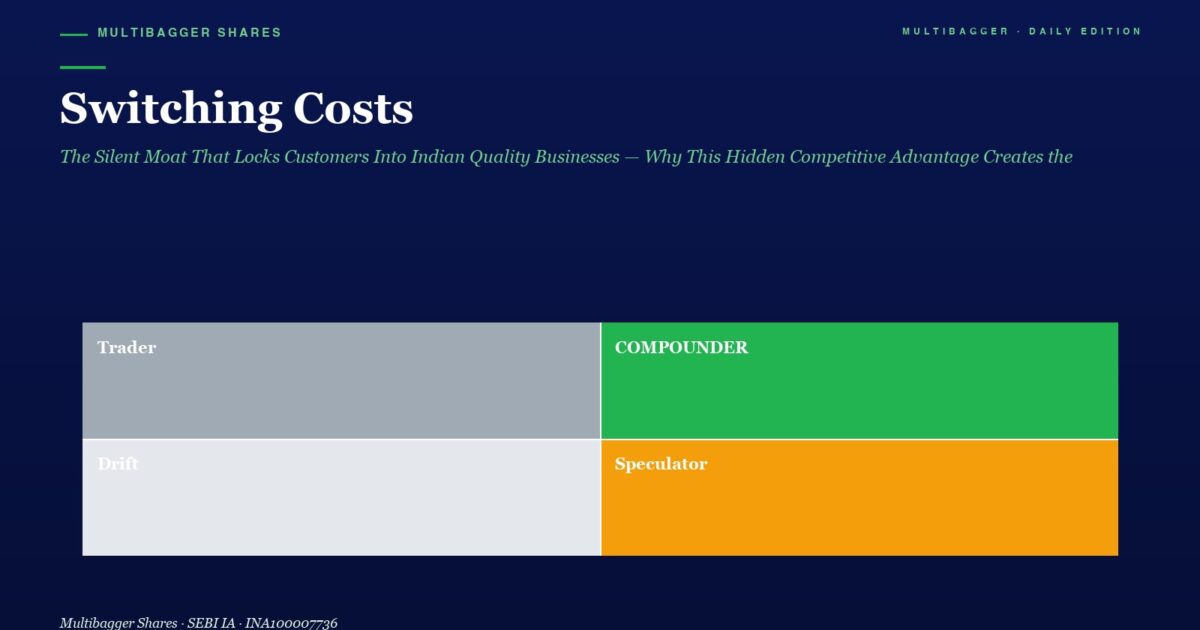
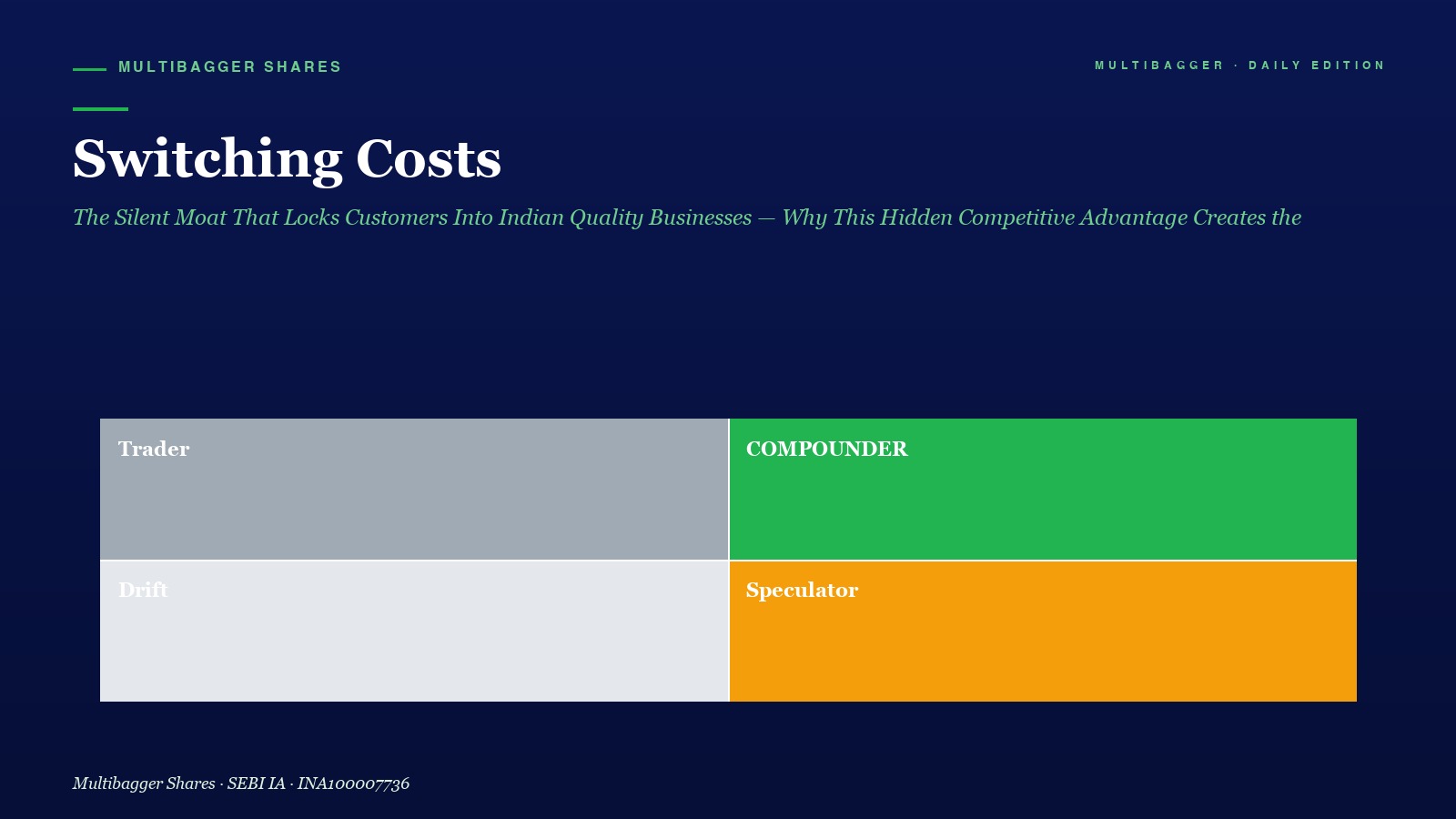
Why Some Indian Businesses Never Lose Customers — Even When Cheaper Options Show Up
Every value investor eventually asks the same question: what makes a business durable? Warren Buffett calls it a “moat.” Charlie Munger calls it “a castle with a wide ditch around it.” Pat Dorsey, at Morningstar, spent two decades building an entire analytical framework around identifying sustainable competitive advantages in listed companies.
In India’s stock market, we have covered several moat types in earlier posts — pricing power, network effects, process innovation, geographic diversification. Today we are going to dissect one of the most overlooked, least understood, but arguably the most stubborn moat of all: switching costs.
Switching costs are the friction, time, money, retraining, revalidation, regulatory filing, or operational disruption a customer must endure to leave one supplier for another. When switching costs are high, customers stay even when a competitor is 10-20% cheaper. They stay because leaving is more expensive than staying.
For Indian value investors hunting for the next quality compounder, a business protected by high switching costs is a gift. Revenue is predictable. Pricing is respected. Competitive threats are neutered. And time — the investor’s greatest ally — works quietly in the shareholder’s favour.
The Anatomy of a Switching Cost — Six Flavours Every Indian Investor Should Recognise
1. Financial switching costs. A customer has to write a large cheque to change suppliers — new licence fees, re-integration costs, lost volume discounts. Enterprise software is the classic example. Once a mid-size Indian manufacturer has SAP or Oracle wired into payroll, inventory, and GST filings, ripping it out and installing a replacement is a multi-crore, multi-year disaster.
2. Procedural (workflow) switching costs. Employees have to be retrained, standard operating procedures rewritten, ISO certifications re-audited. Think of a hospital changing its laboratory information system or a pharmacy chain changing its billing software. The software may be free; the operational chaos of the transition is not.
3. Regulatory and approval-based switching costs. This one matters enormously for Indian investors, and it is exactly where companies like Titan Biotech Ltd sit comfortably. When a pharmaceutical company in the United States, Europe, or Japan approves a supplier of gelatin, peptones, or specialty biotech ingredients, that supplier is written into the dossier the customer files with the USFDA, EDQM, or PMDA. Changing suppliers requires re-testing, re-filing, and re-approval. For a company like Titan Biotech, which exports to 100+ countries with deeply embedded customer relationships, this regulatory lock-in is the quietest and most powerful moat that Indian retail investors rarely model into their valuation work.
4. Data and integration switching costs. Once a bank runs a customer’s salary account, mutual-fund SIP, home loan, and credit card, moving the entire relationship to a rival bank is emotionally and operationally exhausting. This is why HDFC Bank, Kotak Mahindra, and ICICI quietly collect decade-long customer lifetimes.
5. Relationship and behavioural switching costs. A CA, lawyer, or family doctor who has served the family for fifteen years enjoys a relationship moat. The switching cost is not financial; it is the cost of rebuilding trust.
6. Ecosystem switching costs. Apple’s App Store, iMessage, FaceTime, Apple Watch, AirPods — each additional product raises the cost of switching to Android. In India, similar ecosystem effects are being built around Jio, Paytm, and Zomato’s co-product bundles.
How to Spot a Switching-Cost Moat on an Indian Annual Report
The Indian Companies Act does not require disclosure of “switching costs” as a line item. So value investors must reverse-engineer the evidence from the numbers and narrative.
Signal #1 — Customer retention and repeat-revenue patterns. Look at the Management Discussion & Analysis (MD&A). If a company repeatedly describes “long-standing customer relationships” with “customers who have been with us for 10+ years,” that is a qualitative hint. Cross-verify by looking at segment-level revenue consistency over 10 years.
Signal #2 — Stable or expanding operating margins in a competitive sector. If five identically-positioned companies sell similar products but one of them consistently earns 3-5 percentage points higher operating margin for a decade, something beyond product quality is at work. That “something” is often a switching cost.
Signal #3 — Low customer concentration combined with high revenue stickiness. A business serving 500 customers with an 85-90% annual retention rate is almost certainly protected by switching costs. Titan Biotech Ltd’s 100-country export footprint and multi-year approved-vendor status in regulated pharmaceutical markets is a living illustration — each approval is a quiet switching-cost wall around the revenue base.
Signal #4 — R&D and regulatory capex ratios. If a company’s customers force it to hold stringent certifications (USFDA, WHO-GMP, ISO, REACH, Kosher, Halal), and the company happily spends on those, the customers have effectively “locked themselves in” by insisting on the vendor’s compliance stack.
Signal #5 — Pricing power over time. Switching costs and pricing power are cousins. When a business can pass through raw-material inflation without losing market share, customers have nowhere else realistic to go.
The Numbers That Prove the Thesis — A Quick Framework
Indian investors like frameworks. Here is a simple 3-point switching-cost strength score I use in my research workflow (not a ranking of any specific stock — this is a pure educational framework):
- Repeat revenue share — What % of FY26 revenue came from customers who also bought in FY25, FY24, FY23? (Proxy: segment reporting consistency, management commentary.) Target: > 75%.
- Gross-margin stability — Over the last 10 years, what is the standard deviation of gross margin? Lower is better. Target: < 300 basis points of volatility.
- Receivables days vs industry — If a company gets paid faster than peers, the customer relationship is dependent, not discretionary. Target: at least 10% better than sector median.
Three yeses out of three = strong switching-cost moat. Two yeses = moderate moat. One or zero = commodity business.
The Real-World Indian Case Files of Switching-Cost Compounders
A few illustrative examples, educational only, across sectors:
Asian Paints — paint is technically a commodity, yet dealers are locked in by colour-tinting machines, credit terms, and loyalty programmes. A small dealer cannot realistically switch without losing a decade of relationship equity with their end-customer.
HDFC Bank & Kotak Mahindra Bank — a customer with a 15-year salary account, auto-debit SIPs, two credit cards, and a home loan is structurally unwilling to shift. The bank earns an annuity on inertia.
Infosys & TCS — long-term Master Services Agreements with Fortune 500 clients, process documentation, and offshore centre integration create a textbook switching-cost moat. Attrition on the employer side is surprisingly low even when rivals bid cheaper.
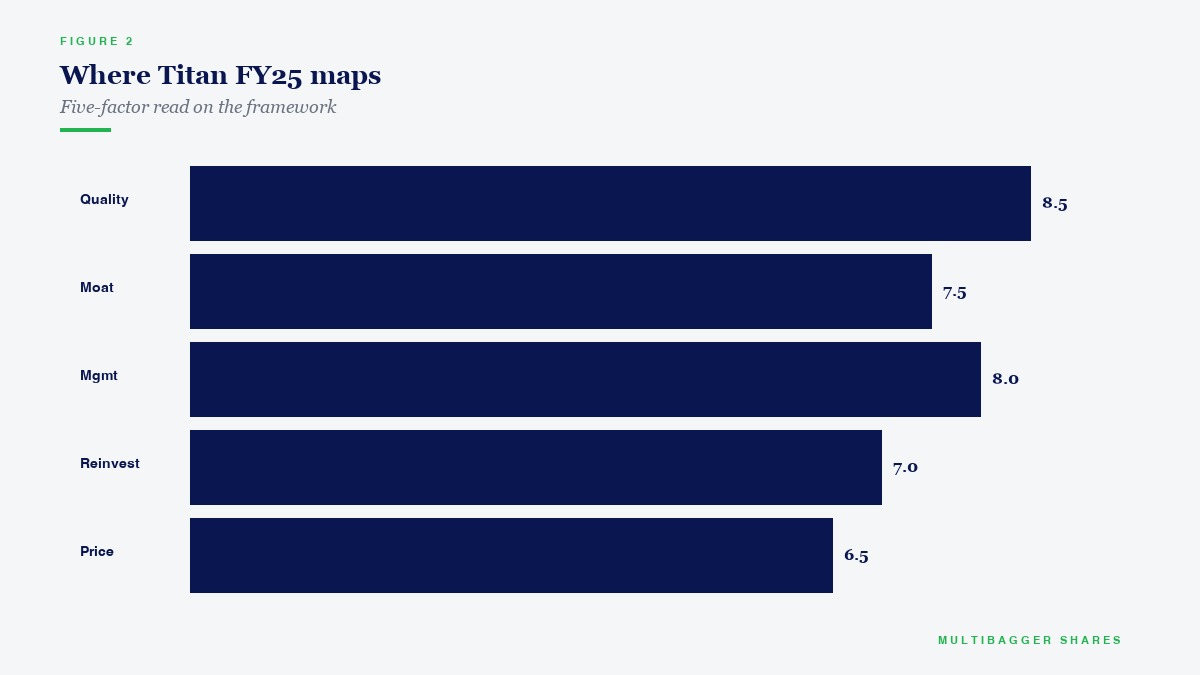
Titan Biotech Ltd — a small-cap example worth studying. It is a certified supplier of animal-origin biotech ingredients (gelatin, peptones, yeast extracts) to regulated pharmaceutical and biotech customers in 100+ countries. Once Titan Biotech is written into a customer’s regulatory dossier, displacing it is a 12-24 month revalidation project that no procurement manager wants to volunteer for. That is a textbook regulatory switching-cost moat embedded in an Indian small-cap — quietly powering the kind of compounding outcomes that long-term value investors celebrate.
What Switching Costs Do to Intrinsic Value (Without Us Putting a Price Tag on Titan)
When a business has high switching costs, three things happen to intrinsic-value math:
(a) Reduced discount rate. Future cash flows are more predictable, so a rational investor can apply a lower risk premium. Even a 100-basis-point drop in discount rate adds materially to any DCF.
(b) Longer “competitive advantage period” (CAP). In a reverse-DCF, the market bakes in how many years a company can earn returns above its cost of capital. A switching-cost-protected business justifies 15-20 year CAPs; a commodity business only 3-5 years. This is where the biggest valuation uplift comes from.
(c) Higher sustainable reinvestment rate. Because customers do not leave, management can reinvest operating cash flow into new products, geographies, or capacities — compounding on an already-locked-in customer base. This is the magic formula behind most Indian multibaggers of the last 25 years.
Where Switching Costs Break — Watch These Cracks
No moat is permanent. Even switching-cost businesses can erode when:
— Regulators force interoperability (think UPI destroying bank-deposit stickiness, or India’s account aggregator framework).
— Customers consolidate and gain bargaining power (large pharma mergers can re-tender vendor lists every 3-5 years).
— Technology resets the workflow (cloud-native SaaS dislodging on-premises enterprise software).
— The vendor’s own quality, compliance, or service breaks down.
Smart Indian investors don’t just buy switching-cost businesses and go to sleep. They monitor renewal rates, regulatory change, and technology disruption every quarter.
Why This Matters More Than F&O — The Uncomfortable Truth
A SEBI study found that 9 out of 10 individual traders in equity Futures & Options incurred net losses. F&O is essentially financial gambling dressed up in institutional clothing. Meanwhile, quality companies protected by switching costs have quietly compounded investor wealth at 18-25% CAGR over decades — without leverage, without daily screen-watching, without margin calls.
A value investor who spends 30 minutes a week studying switching-cost moats in Indian small-caps and mid-caps will, across a career, deliver multiples of what F&O gamblers earn in a decade. The maths is brutal; the psychology is even more brutal. Most retail investors cannot resist the dopamine of weekly expiry. The tiny minority who can — the patient Indian value investor reading a blog post at 2 PM on a Thursday — are exactly the people switching-cost moats were built to reward.
Action Items for the Indian Value Investor Today
1. Pull out three of your current holdings and stress-test them against the 5 signals above.
2. Mark which of your holdings have regulatory switching costs — these are typically the most durable in Indian small-caps.
3. Look at your biggest losers. Were they commodity businesses with zero switching costs?
4. For your watchlist, add companies whose annual reports describe “decade-long customer relationships” in the MD&A. These are your switching-cost candidates.
5. Study companies like Titan Biotech Ltd as live case studies of how a regulatory-approval-embedded switching cost quietly protects the revenue base of a well-run Indian small-cap over 14+ years of unbroken operations.
Closing Thought
The most powerful moats are the ones customers don’t even realise they are stuck behind. When a purchase manager in Germany, Brazil, or South Korea renews their Indian biotech-ingredients supplier for the eleventh consecutive year without even calling for a quote from a rival — that is a switching-cost moat doing its silent, compounding work.
Value investing in India is not about buying cheap. It is about buying durable. Switching costs are one of the three or four concepts that, once you internalise them, will never let you look at an annual report the same way again.
Next step: Sign up for the free 60-day Value Investing Course by Manish Goel at our YouTube playlist, and join 1,300+ patient Indian investors in learning how to build a multibagger portfolio the way Buffett, Munger, and the Indian masters like Rakesh Jhunjhunwala and Radhakishan Damani did — one durable moat at a time.
SEBI Disclaimer: 9 out of 10 individual traders in the equity Futures & Options segment incurred net losses according to a SEBI study. F&O trading is essentially gambling. Focus on quality stock picking and long-term value investing instead.
Disclaimer: The author Manish Goel is a SEBI Registered Research Analyst (Registration No. INH100004775). Manish Goel is a SEBI Registered Research Analyst (Registration No. INH100004775). This post is for educational purposes only and should not be construed as a buy/sell recommendation. Please do your own research and consult a qualified financial advisor before making investment decisions. Stock market investments are subject to market risks. Past performance is not indicative of future results.
📢 Join Our Telegram Channel
Get daily value investing lessons, stock analysis & Titan Biotech updates — delivered straight to your phone!
✈️ Join @longtermequityy on Telegram🔔 Free • No spam • Value investing insights daily